“Tales From The Jails”
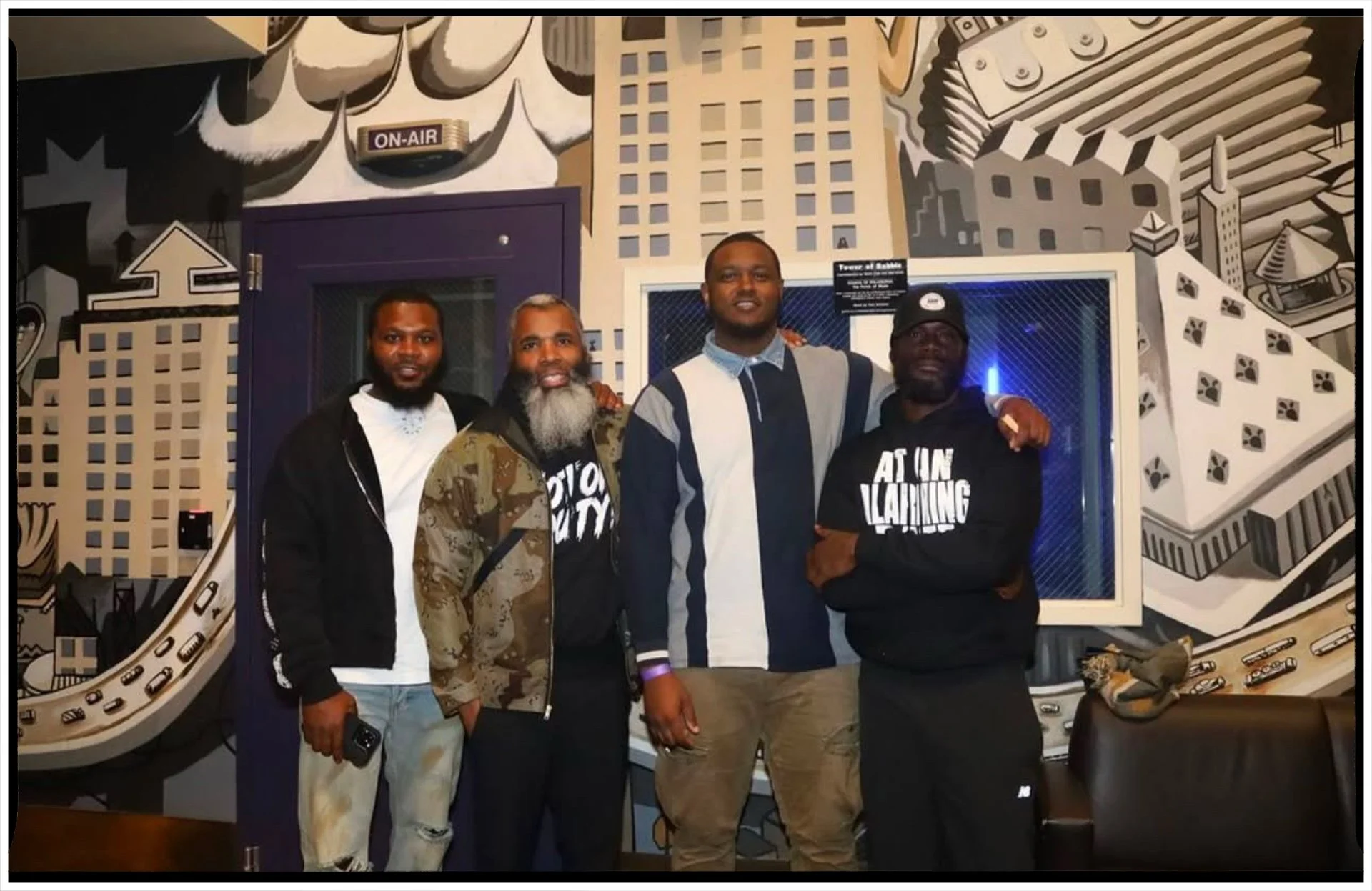
With Dot, Tawfiq & Black - World Cafe Live
THE MEN
An Analysis of Tales From the Jails — Live at World Cafe Live
I didn't pull up to World Cafe Live as a casual fan. I listen to these guys every day — it used to be the YouTube videos, now it's Apple Podcasts on my drive every morning. Friday night was my first time seeing them in the flesh, and I came the way I come to everything: to be in the moment, and to watch the moment at the same time.
Doors opened at 7. I got there around 8:10 and I wasn't late — they let it be a mixer first. Dark room, stage lit up nice, bar and food, good ambience. Real setup. First person I see when I walk down is Black — the host who did 20+ years in the federal penal system. He greeted me warm. I dapped him up and my words were, "Damn, it's crazy to see you in person. Good to meet you."
I got a tequila and cranberry at the bar, $11 with the gratuity already added. People were dressed nice. And I noticed the room itself, because the room was saying something: it was an environment of people that, for real, felt like a hood jawn in the nightlife — but everybody was there to talk about something positive. I think that may be the first time I've encountered that. It wasn't the men-versus-women debate. It was hood niggas who were, under all pretenses, good people and good conversation.
I took a seat in the front. The room wasn't full but it wasn't empty either. The guy behind me — I asked if I was in his way, he said no, and a conversation just happened, natural. We talked about how we both love the podcast and neither one of us has done one day of jail time. The show is intriguing to us, and it's also motivating to stay out of there. My reasons may be different from his, but it's all the same result.
The Opener
Comedian ChuChea opened for them. This is their second live event — I missed the first one. I've seen ChuChea on Instagram and thought he was mildly funny, so he really surprised me: he had actual material. Real jokes. He clowned Black and Tawfiq for being ghetto and starting late, and I laughed and agreed in the moment — but later I realized I'm glad they didn't start at 7, 7:30. It gave people time to mingle, get drinks, and chill. ChuChea's style is raw, and he wrapped it up perfectly to introduce the hosts: Black, Tawfiq, and Dot.
The Hosts
Tawfiq starts the show calm, just like the podcast, and then Black carries it with his stories and antics. Black truly is a star. To have done so much time and still have a great light — he'll tell you the light came over time. I believe he's always had it. But he'll also tell you what it cost: he had to "put on a gorilla suit every day, 24/7, 365."
Black is a reader, too. I can tell from his vocabulary — even though he pronounces words funny at times. As a reader, I relate to that heavy. Just because I don't pronounce the word correctly doesn't mean anything — I've read it, and I know exactly what it means.
From my understanding of their relationship: Black is the younger homie who did a bunch of time. Tawfiq is the oldhead — slightly older, did little to none, and became successful through multiple business ventures, including this podcast. He held Black down while he did his bid. Tawfiq has a lot more grey in his beard than I expected, but it fits him and the equation very well. He's well-spoken with great cadence, mature but playful — the "pause / not on duty" game stays in rotation. And watching them, you can see it plain: Tawfiq is extremely proud of Black, and Black mutually appreciates Tawfiq. As a moderator Tawfiq moves everything along smooth. Black entertains and speaks from the heart. They're a great duo.
Then there's Dot. Dot is the younger homie for sure — from Norf Philly, the part where I grew up. I've met him before through Endangered Kind and John, who does great community work in Norf. From my view, Dot is every bit of the "cool kids" and tough guys who did some time — but he has a cool homie from around the way in John Solomon, and the vision and knowledge to do better for the community. Dot and Black found out recently that they're cousins. It all fits well.
They brought up a guy named Noodles who didn't stay on long, and then T-Y, who stayed on longer sharing his story about his time. And Black told his own: being young, the pressure of wanting to get the girls. A pretty girl asked him to go with her to the nail salon — not to pay for her nails, she just wanted a cheesesteak after. He didn't have the money. He ordered the food, stalled, then dipped on her. The embarrassment of that moment — not having it — made him want to sell crack. This is like '85 he's saying. It's a funny story the way he tells it, but he made sure to be real about it: this is something that turns young boys with no guidance to resorting to selling drugs.
The Cars, and My Question
One thing that stuck out for me was them talking about the "cars" in jail — how you basically ride with your people. If you're from Philly, you ride with the Philly car. And in there, the Muslims are damn near a "car" itself. T-Y explained situations, paperwork, men having to show they didn't tell. He said usually there's a "shot caller," but Philly didn't have one — they decided and talked things through as a collective. "The Men." They refer to themselves as that a lot.
And as he's explaining how they organize in there, my frustration builds a little. Because as thurl as that sounds — why don't we have that same structure out here, amongst "The Men"? I feel like the young niggas run amuck and "The Men" don't come together. The former wild ones don't do a good enough job taming the young wild ones. To me.
So I asked. "Why don't we have that same structure out here on the street?" The first two times it didn't get heard. The two ladies next to me said, "Yeah, that's a good question — say it again, baby." Third time, I got heard. A guy a few rows back said, "That's a dumb ass question." He said it two times. Now, I'm very much a gentle giant, but this could be dangerous for me, because this IS the topic I'm sensitive, emotional, and active about. This is my whole thing. This certainly is NOT a dumb ass question. So I turned around and said, "Nigga, how?" — men can talk aggressive and it just be the heat of the convo; I know I'd had a couple drinks at this point. His response: "That's in there, and it's amongst criminals — that's a dumb ass question. We outnumbered in there." And I responded: "Nigga, we outnumbered out here!"
Oh boy, I could've took over the whole show following that. Some ladies agreed, and maybe a guy or two. Honestly, I don't think any of the hosts really responded to it — they continued talking about the topic. That was a bit disappointing for me. Maybe because I didn't make it a big enough issue. But I also think my comments toward topics like that tend to bother guys from that background, and guys in the neighborhood — especially the "tough guys / cool guys" types. To me, it's the root of the issue.
Because here's how I see it: in jail, the guys are scared to be anything other than the tough guy. To me it's just like elementary school — especially from where I'm from, T.M. Peirce. A lot of neighborhood kids from broken homes, a lot of class clowns. The school-to-prison pipeline is a real thing. But these are really also OUR MEN. So to me it's important that we all are organized, with a good mindset and beliefs of ourselves. And I hate that a lot of us have to go to prison to get this education, this correction, these manners and such.
Disenfranchised Men
I've experienced this with my dad. Because he did a lot of time in jail, that's most of his conversation. And it could — and has — felt before like he's glorifying it. But I understand that he's not. That's his story, and he needs to, and kinda only can, to an extent, talk about that. And he needs to feel good about surviving that. Because although it was a mistake, a wrong way of living that led him there, there is honor in getting through it and handling your punishment. Even if it is depleting you. Even if you have to self-reform.
I felt some of that in the room Friday — from some of the guys in the crowd, and from T-Y. There were guys in that crowd who did time with them, adding comments from their seats. One of them was very active and talkative, and Black called him messy for saying names and saying "put it on the table" — and messy is a word I would agree with. I think Black is a little more evolved than his friends, but he's leading the way, in a positive way, and I'm happy about that. For my part, I truly understood what I was hearing Friday, and I got to sit in and listen and take that in.
These are disenfranchised men. And really, it is a unique experience for us — Black people whose roots are from slavery, in this country specifically. I hear a lot now of British and Haitian and other Blacks saying we are lazy and yada yada, but our experience is very different. Our bloodline is connected, but our experience, our path, and I believe our destiny is different. Our pain is — and so will our glory.
My Father
My father did 16 on a 15-to-30 that he was sentenced to when I was 9 months old. I did that time with him. I remember writing him and asking a bunch of childish questions, but I was genuinely intrigued: Do you have a TV? What do you be doing? Is the food okay?
My dad was 17 when he got locked up. I was also nervous growing up — I didn't want to seem "soft" or corny or whatever. But one day, on one visit, it was real for me when it was time to leave. I hugged him and cried. I was about 10.
When he came home the first time, he was still 17. Then he went back before I could graduate senior year, and then he got out again. And I was older than my dad.
I had to humanize my father. I had to realize I had the tools to make him someone he necessarily wasn't, because that's who I needed him to be. My dad still needs some reforming. But this show makes me feel closer to him in the way that is positive — not how I once tried in high school, for whatever reason of wanting to be "gangsta." I fell for the same glitz and glamour of a street lifestyle, and I feel dumber for it, because I had the support and knowledge poured into me and still went that route for a short time. Thank God I didn't have to go to jail.
Books and programs like the Bright Lights program let my mind build a place where I could think of things differently from what was directly in front of me. A book called "Monster" by Walter Dean Myers had me crying in 4th grade — that was my father. And then being introduced to "ancestors" through the Bright Lights program — Stokely Carmichael, Garvey, and X. They had become my father.
When I look at my little cousin, I'm so happy he is in a space where he actually gets to be a boy and grow into a man — even though where we are from, you usually feel the need, or have to be a man, well before the time for you to be. You don't get to grow into it. My little cousin lost his father at about 4 to gun violence. He's 8 now and doing "great," despite. But I know about not having a dad. You can't really say great.
That's also why I gravitated to artists like YoungBoy. He's raw, and he raps and sings about the hardships of being a "man and standing on principles" while navigating a hood and a life you're born into — but having sorrow over having to. But as I get older, and so does he, I can't commend those who have influence and still make self-destruction seem cool. I gravitated towards new friends and environments — which I also had the tools to do. I started listening to Rasta music, which brought me back to something spiritual and soulful and positive, like the soul music — James Brown and Al Green and Anita Baker — had did for me when I was a kid by my grandparents.
Thank God for grandparents, by the way. Ones that have structure and can give you game. I have two on my mom's side, a MomMom and PopPop that are married, who gave me my love for music and movies and stuff like that. On my father's side, his mom was a cop — she gave me the word, a very religious lady, kind-hearted but stern. And his dad, who we all have the same name, is a "seeker of knowledge," as he calls himself. Muslim, but studies it all. He gave me the Black's Law Dictionary.
The Book
"Question me not, until you first question yourself! Instead of you asking me 'why' I have not granted you complete freedom, you tell Me, 'why' I should?!? Who said that you have made yourself deserving of any freedom, Blackman?"
(Stop—Think... and then stop and think again.)
— Akil, From Niggas to Gods, from the chapter "Do 'Niggas' Deserve To Be Free???"
I love that chapter because it challenges you to think about you versus you. Are we doing things that are self-destructive, and feel deserving to enjoy life to its fullest? Freedom is a luxury, and we must refine ourselves in order to truly be free. And not just in jail either — some people are free, walking around with their mind and heart in prison. To me, that may be worse.
After the show, I decided to stick around a little, watch the aftermath, pass my cards along, and tell Black again about the book. I could've brought my only copy, but that's my only copy. I'm making a couple dollars now, so I'll offer to send one, just to make sure. While waiting, I got to see them take their pictures with people, smile and interact. Very funny for me, because I watch like a fly on the wall — but I stand 6'6", 280. Still, I stand firm, and watch, and wait.
Tawfiq is very genuine, an older elder vibe. He didn't just take one card — he took 30, 40 cards, and actually asked what the brand was, and offered to promote: DM the page, and I got you. I know I'm 28, but I still feel like a young guy, and I think all guys, when there is someone older, it is very beautiful to feel like there is an elder who is authentic and caring and considerate.
And Black was equally as genuine. He shook my hand and held on to it and asked me, "Wait — tell me why you want me to read the book." Tawfiq standing nearby talking about "not on duty," like bro, chill. But Black was genuine, and I want to answer him fully here, the way I couldn't in the moment:
I want you to read "From Niggas to Gods" because it offered me great perspective, and you seem to be an avid reader. The style of the book is very good. The voice of the author speaks through as a wise oldhead giving you very good game, and it is digestible for people like us. Much like what you and Tawfiq provide. That's why it'll hit you. And bigger than that: you have a platform where you speak to the youth about the experience of prison and staying out. Even if it isn't through me, I want the contents of that book to travel and get out.
The Flowers
It was beautiful to see these men receiving their flowers — taking pictures, getting some stardom — under a very positive message and event. There was no shooting and no bullshit. Great.
All in all, it was a great set and a great event. I'm very interested to see more, and what comes from more. It's so refreshing to be able to hear the conversation amongst convicts and men — Philly men, Muslim men — under the name of positivity. Extremely pleasing, and I can listen to that all day. Usually guys don't talk like that, and you're not privy to the talk amongst "gangstas" that is raw and real and giving game and wanting to spread a positive message.
I left thinking about the event, their words, my experience, their questions — and what I could add to True1nBlood. This is what I gathered. This is what I do: I take in what moves me, I analyze it through my life, and I produce something that shows how it came through to me.
— Khatib, True1nBlood
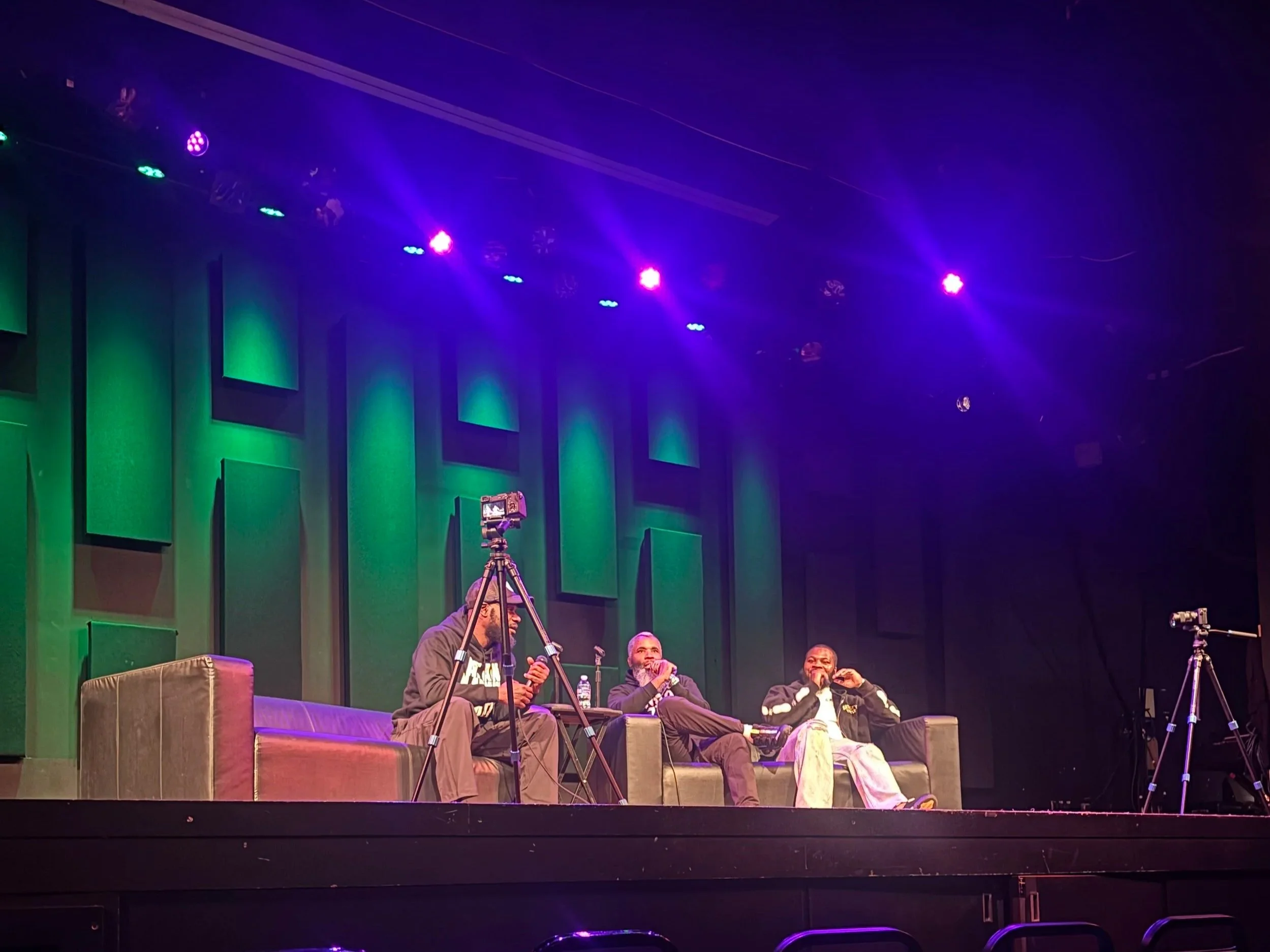
Hosts on stage
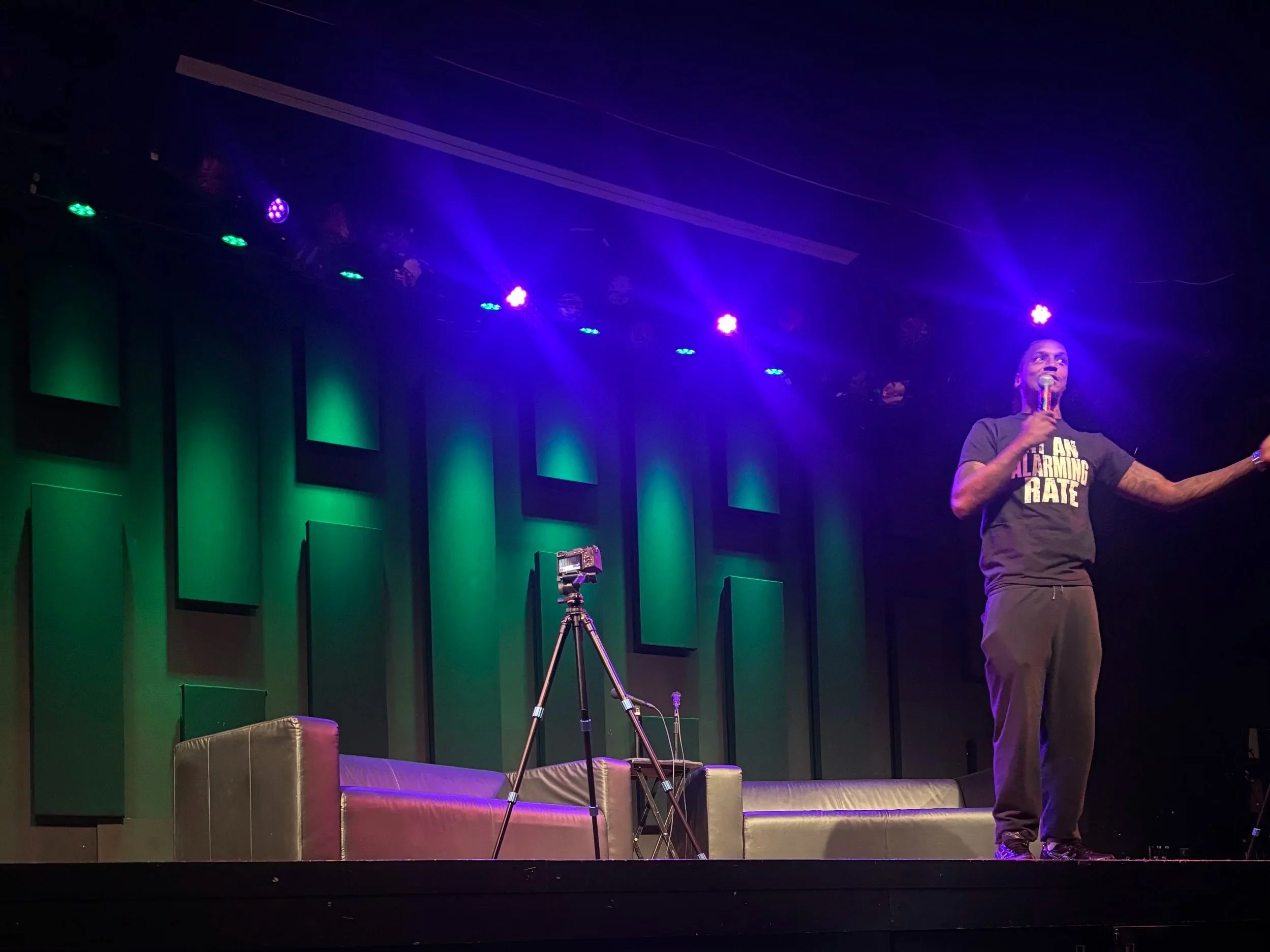
ChuChea on stage with a good opening set.